



Umbria Jazz Feast: Where Global Sounds Meet Italian Streets
In his newly released documentary film, Umbria Jazz Feast, UC Davis Professor of Music, Pierpaolo Polzonetti, investigates the perceptions and identities of jazz as it intersects with the cuisine, art, and culture of locals and visitors in Perugia, a medieval town in central Italy. A musicologist specializing in music and food, Polzonetti focused on how the festival enabled a synesthetic experience; that is, one in which different senses are simultaneously engaged.
Global Support and Collaboration in Italy
The Eivind G. Lange and Mary G. Puma Engagement and Research in Italy Fund, along with a Global Affairs Seed Grant for International Activities and support from the College of Letters and Science and the Department of Music enabled Polzonetti to conduct research and produce the documentary. The Research in Italy Fund’s mission — to support collaborative projects with Italian institutions — allowed for close collaboration with Alberto Guerri, a videographer from the Italian national school of cinematography, and for a dialogue between two Italian filmmakers at the forefront of research in audiovisual ethnomusicology in Italy: Marco Lutzu, from the University of Cagliari, a scholar and practitioner of audiovisual ethnomusicology and Giovanni Giuriati, director of the Intercultural Institute of Comparative Music Studies of the Cini Foundation of Venice, an institution at the forefront of audio-visual musicological research.
Globally Recontextualizing Jazz
In considering the synchronic history of Jazz, or how the whole history of jazz is present during the ten days of the Umbria Jazz Festival, the film also tracks how jazz is recontextualized in a global, or glocal context. With roots in Africa, the art has spread to cities like New Orleans, Chicago and New York, becoming a means of expression and celebration that involves feasting, dancing, drinking, singing and exchanging ideas among musicians and the audience from many different places.
Polzonetti hopes “the film shows that this original spirit of jazz reemerges even in a medieval Italian town like Perugia, where music creates a shared space in which a cross-section of global humanity comes together.”
Polzonetti embraces the term “glocamalgamation” — a concept coined by media theorist Fabienne Darling-Wolf that describes the cross-fertilization of local cultures across the globe, or translocalisms. He comments on how increasingly necessary it has become, especially during a time when we are so polarized by geopolitical conflict, to witness something as refreshing and positive as jazz’s inclusion. To him, jazz is a tool that can bring us together, given its origins in the struggle for freedom rooted in the African American experience.
Feasting at the Umbria Jazz Festival

The film discusses enogastronomic aspects of the festival linked to jazz music, with the word “feast” directing our attention to the presence of food in popular festivities rooted in Medieval carnival culture. In his book, “Feasting and Fasting in Opera,” Polzonetti employs the same language as he considers the relationship between music and food, or what he calls “gastromusicology.”
Beyond their research interests, Polzonetti and Guerri love food and how much care its preparation requires. Polzonetti recounts how one of the chefs they interviewed, Luca Pisauri of Il Gufo (The Owl) Restaurant, compared himself to a jazzman because of his improvisation; he goes to the market early to create his menu with the best ingredients he can find.
It is in local restaurants, often off the beaten track, that we hear edgy music at this festival. “We filmed musicians from Mali playing in another restaurant, where people could eat local dishes while listening to traditional African music. There’s something powerful in that,” Polzonetti observed. It becomes easy to bridge the gap between traditions with food and music — here, they find a way to work together almost naturally.
How “Umbria Jazz Feast” Reimagines Jazz Documentaries
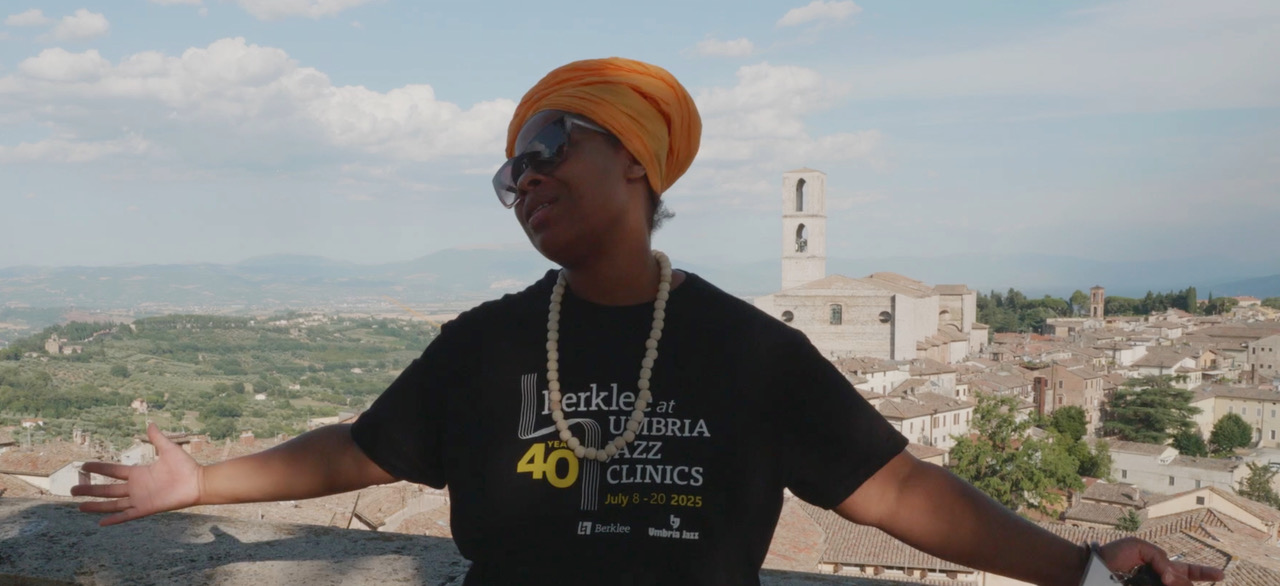
Most documentaries covering jazz tend to feature interviews with musicians and clips from their concerts. In the case of a global jazz festival like Umbria Jazz, however, this traditional approach does not capture the festival’s essence, which occurs in the liminal space where musicians and attendees interact outside traditional venues. The film consists largely of “multi-sensorial and inclusive moments in which the audience stands, dances, and feels included with the musicians as part of the same event. Our cameras move from artists to architecture to people’s expressions and movements, microphones capturing as much ambient noise as possible.” Polzonetti shares that “the medieval city explodes with an incredible energy” that cannot be described in words; he says one would have to see it to understand. The street-forward focus is similar to that of Mardi Gras.
Rethinking the Microhistory of Jazz Beyond Chronology
Over time, working on a documentary detailing the microhistory of jazz shifted how Pierpaolo contextualized the art form, both historically and geographically. Polzonetti teaches a class on the history of jazz, in which the material is typically presented in chronological order and set in urban America. In his film, however, he considers how this approach can be limiting in our present global context. It might be important to track how Swing originally rose to prominence as the sound of the Great Depression, how Bebop anticipated the Civil Rights Movement and how the Black Liberation Movement found its voice in Free Jazz, but this is not the only way we understand music.
“Umbria Jazz Feast” resists the urge to organize coexisting jazz styles chronologically and present them as happening virtually at the same time, in the narrative span of one night and one day. For context, the film follows the presence of light over the course of a day, beginning at night, moving through the day, and returning to night again, even though the film was shot over more than 50 hours across ten consecutive days. Instead of featuring jazz in the morning and later styles in the evening, the film attempts to suggest a synchronic experience of jazz history, from funk to swing to free jazz to gospel music, to its West-African roots and its global offspring. Viewers can “hear different styles from different eras coexisting—each one still alive, each one still speaking to the present, and to our ongoing connection with the past,” Polzonetti notes.
On May 7, the film premiered in Italy at the Casa del Jazz, Rome’s most important jazz venue, which offered two consecutive screenings after the first had sold out. The event was introduced by the former mayor of Perugia, Wladimiro Boccali, and by On. Emanuele Prisco, a congressman and close collaborator of President Giorgia Meloni. Right before the film started, Joanna Regulska appeared on screen for a remote greeting to the Italian audience. After the event, there was a Q&A with Alberto Guerri and a concert by a star of Italian jazz piano, Danilo Rea (who has performed with Chet Baker, Lee Konitz, Phil Woods, Domenico Modugno, and other giants). The film was officially selected as a part of the Madrid Indie Film Festival, an international film festival in Spain.